

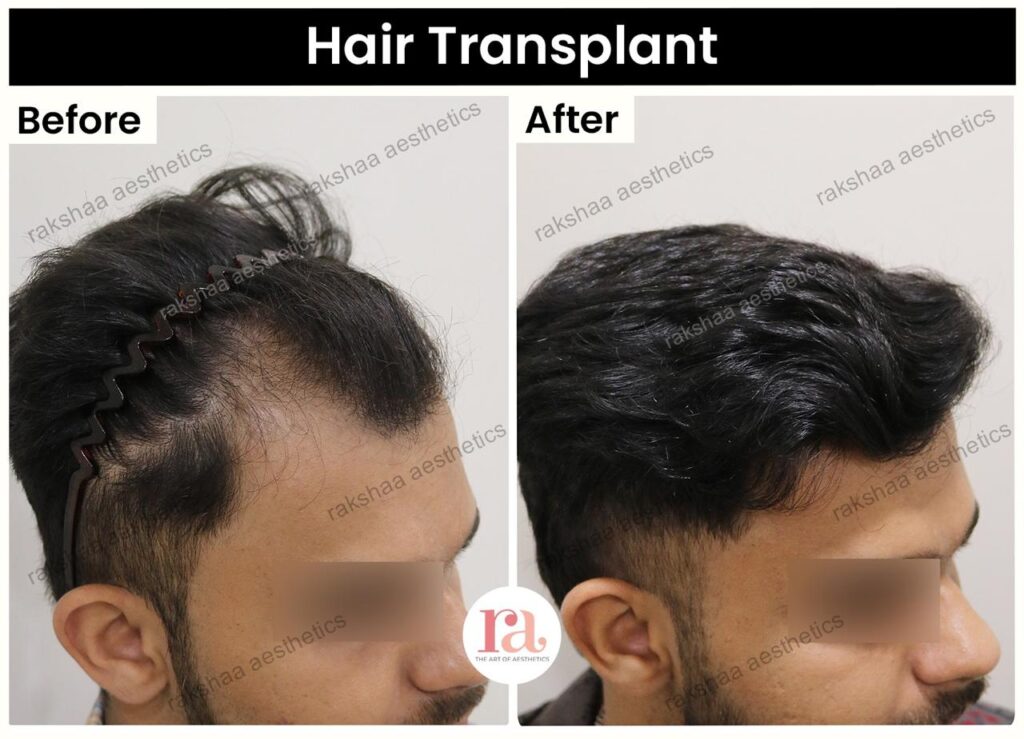
Losing your hair rarely stays just a cosmetic worry. A receding hairline or a thinning crown can change how you see yourself in the mirror, in photos, and in a room full of people. If you’ve reached the point of looking for a lasting fix, you’ve probably come across Follicular Unit Extraction (FUE). It has become one of the most requested hair transplant techniques, mainly because it leaves no long scar, looks natural, and doesn’t demand a long recovery.
At Rakshaa Aesthetics, we know no two people come to us with the same story. Understanding how FUE works, and what it can and can’t do, is the best starting point for deciding if it’s right for you.
What Is an FUE Hair Transplant?
In FUE, the surgeon takes individual hair follicles from a donor area, usually the back or sides of the scalp, and places them in the areas where hair has thinned or disappeared.
Older strip-based methods remove a band of scalp and then stitch the wound closed. FUE skips that step. Follicular units are taken out one by one with fine, specialised instruments, which leaves tiny dot-like marks instead of one long line.
It is most often used for male pattern baldness and receding hairlines, and in some cases for female pattern hair loss. Before recommending it, a dermatologist or qualified hair transplant surgeon needs to find out why you’re losing hair and check whether you have enough healthy donor hair.
Top Benefits of Choosing FUE Hair Transplant
1. Natural-looking results
This is the benefit most people care about. Each follicle is placed to match the direction, angle, and growth pattern of the hair around it, so the new hair blends in instead of looking planted. The hairline is also shaped around your face and age. With careful planning and precise placement, the result looks like your own hair, because it is.
2. A minimally invasive procedure
Since no strip of scalp is removed, there’s no long surgical incision. In the first days you may notice mild swelling, tenderness, redness, or small scabs. That’s normal.
The procedure is usually done under local anaesthesia, though the exact approach depends on your case and your surgeon’s assessment. The surgeon’s experience matters a great deal here, since safe extraction, careful handling of grafts, and accurate placement all affect the outcome.
3. No long linear scar
With FUE, the donor area ends up with small, scattered marks rather than one line across the back of the head. They tend to fade as you heal, though tiny scars can stay. This is a real advantage if you like to keep your hair short.
Its worth being clear that FUE is not scar-free. Taking too many grafts from one area can leave the donor region looking thin or patchy, which is why a good surgeon plans the extraction pattern with care.
4. A comfortable recovery
There’s no long wound to stitch and look after, so many patients find recovery easier than with strip-based surgery. Most people are back to light daily activities within a few days, depending on how they heal and what their work involves.
You will need to avoid strenuous exercise, swimming, and anything that could disturb the new grafts for as long as your surgeon advises. Following the aftercare instructions closely is the best way to protect the new follicles and lower the risk of complications.
5. Long-lasting results
The follicles used in FUE usually come from parts of the scalp that are less sensitive to the hormones behind common pattern baldness. Once they take, transplanted hairs can be washed, trimmed, and styled like the rest of your hair.
“Permanent” doesn’t mean your hair loss stops, though. The hair you didn’t have transplanted can keep thinning over the years, and some patients are advised to use medical treatment to protect it. Results depend on donor hair quality, the cause of your hair loss, the surgical technique, and how well you heal.

6. Better density and coverage
FUE moves healthy follicles from areas that have plenty to areas that don’t. It can rebuild a frontal hairline, fill in certain bald patches, or add density to selected parts of the scalp.
How much coverage you end up with depends on the number of grafts available, your scalp, your hair thickness, and the size of the area being treated. A transplant doesn’t create new follicles. It redistributes the ones you already have, so an honest conversation about what’s achievable is part of any good treatment plan.
7. A hairline designed for you
A good hairline suits the face it sits on. One that’s too low or too straight looks unnatural however well the grafts grow. During your consultation, the surgeon looks at your facial proportions, age, hair characteristics, donor capacity, and how your hair loss is likely to progress.
That last point matters most for younger patients. If pattern hair loss is likely to continue, the hairline needs to look right now and still look right in ten years.
8. Gradual, natural growth
Results from FUE don’t show up right away, and that surprises some people. The transplanted hairs often shed in the first few weeks, which is a normal part of the process. New growth usually becomes noticeable at around three to four months, visible improvement builds over six to nine months, and the full result can take 12 months or longer.
Everyone’s timeline is a little different. Follow-up visits let the medical team check how you’re healing and how the growth is coming along. Mostly, it takes patience.
9. Suitable for different types of hair loss
FUE can be used for male pattern baldness, some cases of female hair thinning, and certain types of hair loss caused by scarring. In suitable cases it can also be used for beard restoration.
That said, transplantation isn’t right for every kind of hair loss. Active scalp disease, some inflammatory conditions, a lack of donor hair, or certain medical causes of hair loss may need treatment first, or may rule out surgery altogether. A proper medical evaluation will tell you which category you’re in.
Who Is a Good Candidate for FUE?
FUE may be a good fit if you:
- Have pattern hair loss or a receding hairline
- Have enough healthy donor hair
- Are in good enough health for a minor surgical procedure
- Have realistic expectations about density and coverage
- Understand the recovery process and are prepared for long-term hair care
Only a consultation with a qualified dermatologist or hair transplant surgeon can confirm whether you’re eligible and go over your alternatives.
FUE Hair Transplant at Rakshaa Aesthetics
Good hair restoration starts with listening. We want to understand your concerns, your pattern of hair loss, and what you hope to achieve before we talk about any procedure. A professional assessment will tell you whether FUE is appropriate and what results you can realistically expect.
Our approach is built on personalised planning, medical supervision, proper hygiene standards, and support at every stage, from the first consultation through recovery.
If you’re thinking about a hair transplant, speak with a qualified medical professional about donor hair availability, the likely number of grafts, the risks, aftercare, and the full treatment plan.
Frequently Asked Questions
1. Is an FUE hair transplant permanent?
Transplanted follicles can keep growing for a long time, but ageing and ongoing hair loss can still affect the hair around them. Your doctor may recommend maintenance treatment.
2. Is an FUE hair transplant painful?
Local anaesthesia keeps pain to a minimum during the procedure. Afterwards, some tenderness, discomfort, or swelling is common.
3. How long does it take to see results?
Early growth can appear at three to four months. Noticeable improvement usually comes between six and nine months, and the final result often takes 12 months or longer.
4. Does FUE leave scars?
Yes, it leaves tiny extraction marks. They’re usually much less noticeable than a long linear scar, but they can still be visible, especially with very short haircuts.
5. How do I know if FUE is right for me?
Book a consultation with a qualified dermatologist or hair transplant surgeon. They’ll look at your hair loss, donor area, and medical history to see whether you’re a suitable candidate.
In Last
FUE offers natural-looking results, a minimally invasive technique, no long linear scar, and the chance of lasting hair growth. For the right candidate, it’s an effective way to bring back coverage and rebuild a hairline.
Still, good results come from careful patient selection, skilled surgical planning, realistic expectations, and proper aftercare.
If you’d like to find out whether FUE is right for you, book a consultation with Rakshaa Aesthetics. We’ll talk through your concerns and your options, with no pressure.