

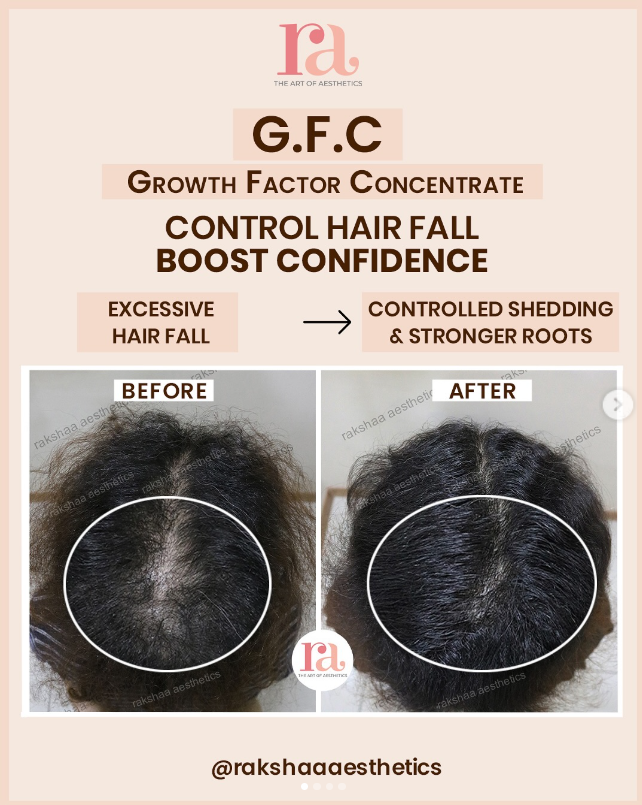
Hair loss doesn’t discriminate it affects men and women alike, and for a lot of people it chips away at confidence more than they’d like to admit. The causes vary widely, but catching it early and matching it to the right treatment gives you the best shot at slowing things down and keeping what you’ve got healthy.
One option that’s picked up momentum lately is GFC (Growth Factor Concentrate). It’s a regenerative treatment built from the patient’s own blood, concentrated down and injected directly into thinning areas of the scalp. Early studies point to real improvements in density and thickness, especially for people dealing with pattern hair loss, though the treatment is still relatively new and results differ from person to person.
At Rakshaa Aesthetics, GFC is one piece of a broader, personalized plan for managing hair fall.
What Is GFC Hair Treatment?
GFC (Growth Factor Concentrate) is autologous, meaning it’s made from your own blood. A small sample is drawn and processed to isolate a concentrated dose of growth factors, which is then injected into the parts of the scalp where hair has thinned out.
Growth factors are signalling proteins the body already uses for tissue repair and cell activity. Injecting them into the scalp is meant to give weakened follicles a better environment to work with and push them toward healthier growth.
The research so far while protocols and quality vary a lot study to study has generally reported gains in hair density and hair shaft diameter among people with androgenetic alopecia.
How Does GFC Help with Hair Loss?
Androgenetic alopecia, the medical term for pattern hair loss, usually shows up as gradual thinning as vulnerable follicles shrink over time. GFC works by flooding the area around those follicles with concentrated growth signals. Depending on the person, that can translate to:
- Support for follicles that have started to weaken
- Denser-looking hair in thinning areas
- Thicker individual strands
- Less shedding, in some cases
- Better overall scalp and hair condition
- A non-surgical route for the right candidates
A 2024 study on concentrated growth-factor injections found measurable improvements in density and other growth markers, with the effects holding up during follow-up.
That said, GFC isn’t a cure-all. How well it works depends on what’s actually causing the hair loss, how far along the follicle miniaturization is, genetics, hormones, diet, and general health.
Why People Choose GFC
It’s made from your own blood. For anyone drawn to a more regenerative, “use what your body already makes” approach, that’s a big part of the appeal.
No surgery involved. There’s no transplant, no removing and reimplanting follicles just injections. That makes it worth considering for people who aren’t ready to commit to surgical hair restoration.
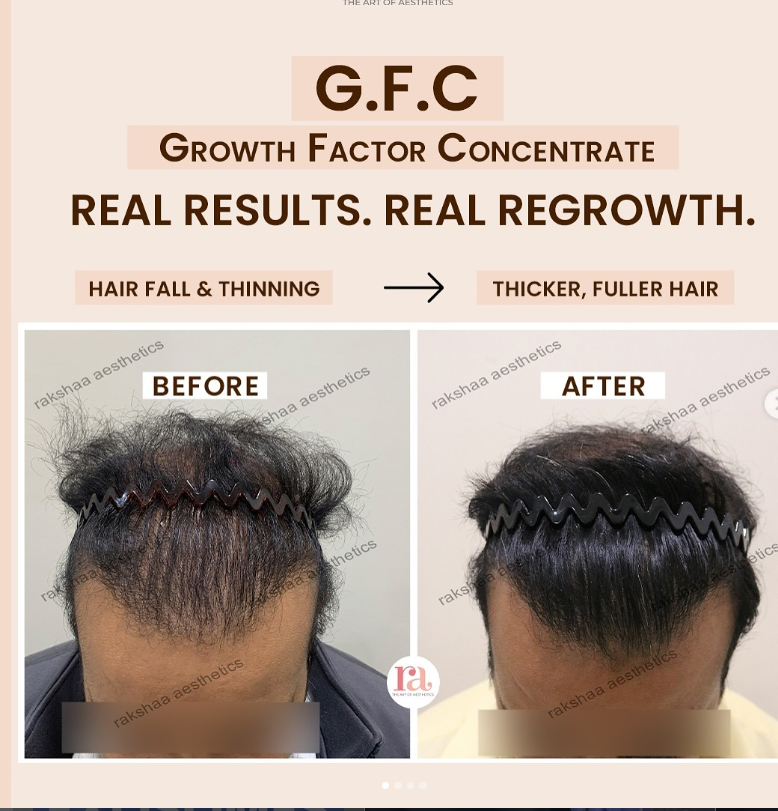
It can improve density. Several clinical studies have reported increased hair density after treatment with concentrated growth factors.
It can thicken existing hair. Thinning isn’t only about losing follicles outright often the strands themselves get finer through miniaturization. Growth-factor treatment has been linked to improvements in hair diameter, tackling that side of the problem too.
Downtime is minimal. It’s typically done as an outpatient visit. You might see some redness, swelling, or tenderness at the injection sites afterward, but the small studies available so far haven’t flagged serious complications.
What Kind of Results Should You Expect?
Hair grows slowly, so don’t expect changes overnight. Some people notice less shedding or a change in texture before they see any real difference in density the more visible improvements usually take a few months to show up.
Clinical studies have generally reported measurable results around the three-month mark, with some tracking continued benefit out to six months. Still, outcomes are individual, how many sessions you have, how they’re spaced, how severe the hair loss is, your age, the underlying cause, and the condition of your follicles all factor in.
Most dermatologists recommend a series of sessions rather than a single visit. Published protocols range anywhere from three sessions spaced weeks apart to other schedules entirely, which is really the point: this needs to be tailored to the individual, not applied as a standard package.
Who’s a Good Candidate for GFC?
GFC tends to work best for adults with non-scarring hair loss, particularly male or female pattern hair loss. It’s generally a reasonable option if you:
- Have early- to moderate-stage thinning
- Are dealing with pattern hair loss
- Want to avoid surgery
- Still have follicles that are weakened but viable
- Are open to combining it with other treatments your dermatologist recommends
It tends to be less effective once follicles have been permanently destroyed, or when the hair loss stems from an underlying medical or inflammatory condition that hasn’t been addressed. That’s exactly why a proper consultation matters before jumping into treatment.
Who Might Not Be a Good Fit?
Thyroid issues, nutrient deficiencies, hormonal shifts, scalp conditions, certain medications, chronic stress, and autoimmune disorders can all drive hair loss and in those cases, treating the root cause matters more than stimulating the scalp directly.
People with advanced baldness or long-established bald areas where follicles are no longer active often need a different approach altogether, like a hair transplant. A thorough scalp exam and medical history review is really the only way to know whether GFC makes sense for you.
GFC vs. PRP – What’s the Difference?
GFC and PRP are cousins, not twins. Both start with a blood draw and processing step, but GFC is built to concentrate growth factors specifically, while PRP centers on platelet-rich plasma.
Some comparative studies suggest GFC edges out PRP on certain density measures, though the evidence base is still thin and protocols aren’t standardized across clinics. One randomized controlled trial found both GFC and PRP produced improvements when paired with topical minoxidil, while another comparison found differences in how the two performed over time. Which one makes sense for you comes down to your specific diagnosis, goals, history, and what your dermatologist recommends.
Is It Safe?
GFC is considered minimally invasive, but no injection-based treatment is entirely without risk. Expect some temporary redness, tenderness, or swelling at the injection sites. Infections and other complications are rare when proper sterile technique is used, but this is still a medical procedure it should be done by a qualified provider after a real evaluation, not handed out as a blanket fix for every kind of hair loss.
Why Rakshaa Aesthetics
The starting point at Rakshaa Aesthetics isn’t “here’s a procedure”, it’s figuring out why you’re actually losing hair. That means a proper look at your pattern of loss, scalp condition, hair density, and goals before anything gets recommended. From there, GFC might be the right call on its own, or as part of a bigger plan.
The goal isn’t to promise a head full of hair, it’s to match the right treatment to the actual state of your follicles and the actual cause of your hair loss.
Final Thoughts
GFC is a promising, still-developing option for people dealing with pattern hair loss who want a non-surgical path to better density and thickness. The research so far is encouraging, but it’s early larger, more standardized studies are needed before anyone can say definitively how it stacks up against more established treatments.
If you’re noticing persistent shedding, thinning, or a receding hairline, it’s worth getting it looked at sooner rather than later. Early evaluation makes it much easier to pin down the cause and figure out what’s actually going to help.
Looking for GFC Hair Treatment in Pitampura, Delhi? Talk to the team at Rakshaa Aesthetics for a personalized hair-loss assessment and treatment plan.
Book your consultation today and take the first step toward healthier, stronger hair.